





When an employee is welcoming a new child, their maternity leave can consist of many different types of leave, depending on where they work and where they live. Maternity leave can include time off provided by federal laws like the Family and Medical Leave Act (FMLA), state statutes, and company policies.
HR’s job is to untangle these provisions. Crucially, leave managers must understand when different leaves can run concurrently and when they stack, extending an employee’s total time off. Determining this raises questions like: Does maternity leave run concurrent with FMLA?
In this article, we’ll answer these questions, dig into the complexities created by state leave laws, and discuss how your organization can ease maternity leave mayhem with purpose-built technology.
Maternity Leave and FMLA: What’s the Difference?
Maternity leave is a deceptively simple concept. When someone refers to maternity leave, it’s easy to think of that leave as one chunk of time off, usually provided and paid for by an employer.
In reality, maternity leave can be so much more. That’s why it’s important that HR can tell the difference between Paid Family and Medical Leave (PFML) vs. FMLA and pregnancy disability leave vs. bonding leave. Maternity leave can encompass all these provisions, which HR can sort into three buckets:
- Federal laws: The FMLA provides 12 weeks of leave to eligible workers. The leave is unpaid, but workers get job protection. Workers can also qualify for leave as an accommodation under the Americans with Disabilities Act (ADA) and the Pregnant Workers Fairness Act (PWFA).
- State programs/laws: Certain states such as California, Washington, and Colorado maintain laws that grant employees paid leave for either pregnancy medical needs, bonding, or both. State programs may also allow for job-protection in addition to wage replacement. These laws come with their own rules regulating eligibility, waiting periods, and benefit-year periods.
- Company policies: Many employers offer parental leave policies and tout them as a major benefit. To learn more about how to leverage these policies as recruiting and retention tools, read our blog: The Do’s and Don’ts of Managing Paid Parental Leave. Sometimes, this leave is referred to as bonding leave. This provision typically applies to all parents, not just mothers and birthing parents. Employers may also provide leave through a short-term disability (STD) that can apply during and after an employee’s pregnancy.
Concurrent Leave: How Do These Leaves Fit Together?
Now that we’ve covered the different types of time off that maternity leave can encompass, it’s time to consider how they fit together.
First, let’s take a moment to define our terms:
- Concurrent leave: When employees use two or more types of leave concurrently, the absences run at the same time.
- Stacked leave: Employees can extend their total amount of time away by stacking leave. By stacking their leave, employees use leaves of absence one after the other, as opposed to taking them simultaneously.
Because there are so many leaves of absence that can happen during someone’s maternity leave, leave managers and HR must understand when policies are running concurrently and when stacking leave is permissible. To remain compliant, HR needs to facilitate proper leave designation and leave coordination, all while maintaining consistent policy application.
As we’ve discussed, maternity leaves can include federal, state, and company policies. Here’s how those tend to work together:
- Federal laws: One of HR’s most frequent questions is whether employees can take maternity leave and FMLA at the same time. According to the U.S. Department of Labor (DOL), FMLA leave may be used at the same time as employer-provided paid leave. Specifically, DOL says, maternity or other parental leave also may run concurrently with FMLA leave.
- State programs/laws: Here’s where things get tricky. Most state leave laws don’t replace the FMLA; they layer on top of it. But every state that has a paid family leave program maintains its own rules and regulations. That means employees may qualify for one but not the other. In New York, employers are allowed to require employees to use FMLA and the state’s Paid Family Leave program concurrently. Paid Family Leave does not, however, replace disability benefits coverage, which New York requires employers to provide. This example illustrates how complex maternity leave can become when multiple policies intersect.
- Company policies: Whether a company’s bonding leave runs concurrent or consecutive with other policies depends on the program.
Need An Example? Consider California.
If you want to understand just how complicated an employee’s maternity leave can be, consider California. California is famously employee friendly. It maintains several state laws with provisions for employees who are expanding their families.
Let’s say there’s a healthcare worker in the Golden State who’s been at her job for five years. We’ll call her Wendy. When she was pregnant, Wendy faced some challenges. She needed restrictions and bedrest before delivering a healthy baby. After giving birth, she encountered a few more medical complications, including postpartum depression.
Wendy’s scenario may be fictitious, but it’s not uncommon. What is everything Wendy could be entitled to?
We’ll start with the federal laws. Wendy would be covered by the Pregnant Workers Fairness Act; the Americans with Disabilities Act; the Family and Medical Leave Act; and the PUMP Act.
Next up: state laws. The list of state laws covering Wendy is even longer. She would be eligible for support under:
- The California Family Rights Act (CFRA)
- California Pregnancy Disability Leave (PDL)
- California’s Paid Family Leave (PFL)
- California State Disability Insurance (SDI)
- California Earned Sick Leave
- California Fair Employment and Housing Act (FEHA)
Finally, company policies. Wendy would likely have access to paid time off, paid sick time, parental leave programs, short-term disability, medical leave of absence, and potentially union programs. Wendy may also qualify for local laws depending on her location.
The chart below breaks down the timeline of events, the conditions Wendy experienced, and the policies that applied.
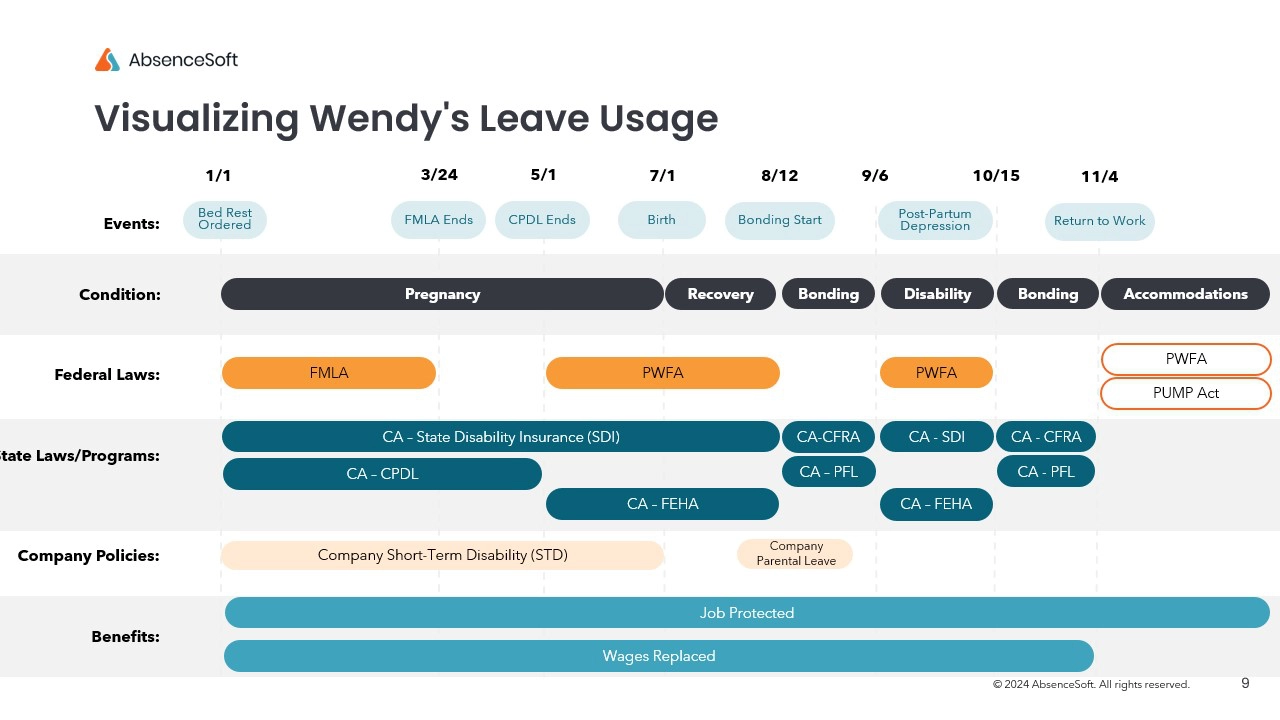
As this chart makes clear, Wendy used many different types of leave, which ran both concurrently and consecutively. During her pregnancy, she was covered by the FMLA, California’s State Disability Insurance and Pregnancy Disability Leave, and her company’s short-term disability policy. Her recovery and bonding periods were covered by the California Family Rights Act, the state’s Paid Family Leave program, and her employer’s parental leave policy.
The Compliance Challenge For Multi-State Employers
With the interplay of continuous and concurrent leave, maternity leave can be difficult to manage. It’s especially challenging for multi-state employers.
Leave managers at multi-state employers face the difficult task of untangling the web of maternity leave policies, which is made far more intertwined by numerous state statutes. HR must remain aware of the states that offer applicable policies, the workers those policies apply to, the provisions they offer, the rules and requirements they entail, and how they interact with other policies.
Of course, many states don’t offer paid family or medical leave programs. But that only adds to the complexity.
Let’s imagine you are a medium-sized employer with three pregnant employees. The employees are all eligible for FMLA leave, but they live in different states — California, Washington, and Idaho.
Using a tool like AbsenceSoft’s Leave Law Lookup, you know that the employee in Idaho is not covered by a state law that would provide paid family or medical leave. But the workers in California and Washington are.
To administer these three maternity leaves, you’ll have to understand California and Washington law. Both of these states provide paid leave, but the details of eligibility, entitlements, and income replacement are different.
You’ll also have to determine whether the leaves of absence provided by these laws run concurrently with other types of time off, including your employer’s policies. For example, Washington’s Paid Family and Medical Leave program may run concurrently with the FMLA where both laws apply. The same goes for California’s Paid Family Leave program.
Management will be simpler for the employee in Idaho, but complexities can arise. The employee may ask about intermittent bonding leave, which is one of the more challenging parts of FMLA management. Or you may need to address entitlement exhaustion or return-to-work challenges. Any of these issues can turn a straightforward case into something far more complicated.
Maternity leave isn’t the only leave of absence complicated by state legislation. Read our blog, 10 Types of Leaves of Absence Employees Can Request, to learn about other buckets of time off.
How HR Manages the Maternity Matrix
Administering maternity leave is no easy feat. It requires accurate, up-to-date knowledge of a legislative landscape that’s constantly changing. It requires coordination of different rules and regulations, some of which overlap or impact each other. And it requires a human touch: HR must be available to lend support to employees going through one of life’s most significant transitions.
Despite the complexity inherent to maternity leave management, many employers are administering it without the help of sophisticated technology. In our 2026 State of Leave and Accommodations Report, we asked HR leaders to tell us how they’re addressing the growing number of state leave laws. Only 38% said they had implemented leave management software with compliance tools. Here’s how the rest responded:
- 41% of respondents said their organization is managing state leave laws manually with spreadsheets, email, and reminders. This was the leading response.
- 35% said they rely on their legal team to interpret changes.
- 34% said they maintain a policy library or internal guide.
- 24% said they outsource to a third-party vendor or insurer.
- 8% said they are struggling, and they haven’t found a solution yet.
How Technology Can Optimize Maternity Leave Management
The manual approach to leave management comes with many risks. The risks are even greater when HR is dealing with a particularly complex type of leave, such as maternity leave. Without an accurate, up-to-date source of information, HR will struggle to designate and coordinate leave properly. And without centralized tracking, leave managers may miss deadlines and over- or under-count entitlement.
A purpose-built platform resolves these challenges and reduces the risk of compliance mistakes arising from human error or misunderstanding. With software like the AbsenceSoft Compliance Engine (ACE), leave managers don’t need to rely on their memory, Google, or ChatGPT when determining an employee’s eligibility or entitlements.
Instead, they have access to a policy library built by compliance experts that supports more than 200 federal and state leave and accommodation laws, including the FMLA, ADA, and PWFA. But ACE isn’t limited to these statutes. Users can add their organization’s leave policies, so they can centrally manage all requests.
The best leave software doesn’t stop at eligibility. Sophisticated platforms streamline processes with preconfigured and timely workflows that harmonize even the most complicated cases.
Modernize Maternity Leave With AbsenceSoft
Coordinating maternity leave by hand is hard work. But that’s not the biggest problem with a DIY approach to maternity leave. When HR manages leave by hand, they could make costly compliance errors, create payroll errors, cause delays and oversights, and leave employees feeling frazzled instead of supported.
HR can minimize these risks by implementing a purpose-built leave management program like AbsenceSoft.
Before Tillamook County Creamery Association partnered with AbsenceSoft, its leave specialist was using Excel to track leaves, storing forms on a shared drive. The approach cost the team time and visibility — two things it couldn’t afford to lose as it managed 400 leaves each year.
When the company fully adopted AbsenceSoft, the platform became its single source of truth, keeping the organization organized, efficient, and compliant. Tillamook’s leave management team estimates AbsenceSoft saves 10 hours a week by sending communications on time, ensuring deadlines are met, and keeping every detail of leave management in one central location.
To learn how AbsenceSoft can help your team modernize its approach to maternity leave and other types of time off, book a demo today.