

Accommodations can be complex for HR to navigate, and requests from employees are increasing. HR managers are under growing pressure to ensure accommodations are handled effectively. As highlighted in our 2026 State of Leave and Accommodations report, however, it’s getting harder for HR teams to provide accommodations in a way that’s both compliant and compassionate.
To better understand the current accommodations landscape, we surveyed 1,200 HR leaders to gather insights into what employees are requesting, what’s working well, and the challenges HR teams are facing. Below, we’ve outlined key trends, but we encourage you to download the full report for a deeper dive into the data.
Accommodations Requests Continue to Rise
Accommodations requests are up. Fifty-six percent of HR managers surveyed reported an increase in accommodations requests in 2025, marking the third consecutive year of growth. Among those who saw a rise, 74% reported an increase of 21% or more.

While increases in requests may fluctuate year to year, the overall volume of accommodations requests is growing sharply over time. For teams that reported increases in each of the last three years, it’s possible that they’re dealing with cumulative growth of more than 125%.
For more information on the rise in accommodations requests, read our 2026 State of Leave and Accommodations Report.
Mental Health, Chronic Physical Conditions Drive Requests
For the third year in a row, mental health conditions were the most common reason employees requested accommodations. This trend underscores the growing importance of emotional well-being in the workplace. Employees are increasingly comfortable advocating for their needs and expect their employers to provide meaningful support.
The next most common reason for accommodation requests was a tie. Physical illness and injury recovery and chronic physical conditions or limitations both ranked second. As the workforce continues to age, HR teams should prepare for an increase in requests related to mobility challenges, ergonomic adjustments, and flexible work arrangements.

With accommodation requests on the rise, organizations should assess their policies and processes to ensure they are prepared to respond efficiently and compliantly. The good news? Most accommodations are low-cost or even free, allowing employers to retain valuable talent while fostering a more inclusive workplace.
Explore our 2026 State of Leave and Accommodations Report to learn more about the factors driving accommodations requests.
Top Accommodations Remain Remote Work and Flexibility
When people think of accommodations, they often picture wheelchair ramps, ergonomic chairs, or closed captions. But accommodations are as diverse as the workforce itself. In reality, the most frequently requested accommodations focus more on when and where employees work rather than how.
Remote work was the most requested accommodation this year, followed by reduced schedules or periodic time off (intermittent leave). Continuous leave came next, closely followed by additional breaks.
It’s worth noting that 62% of employers implemented full or partial return-to-office mandate in the past two years. The shift is likely a key driver of both the volume and the nature of new accommodation requests.
As with any accommodation, HR should engage in the interactive process to understand what employees need to perform their essential job functions. This collaborative approach is especially important for complex requests, including those for remote work.
To discover the other top-requested accommodations, dive into our 2026 State of Leave and Accommodations Report.
Undue Hardship, Manager Issues Rank as Top Challenges
For two years in a row, HR leaders have said that the hardest part of managing accommodations is determining when a request causes an undue hardship. The second- and third-most cited concerns were: managers that don’t understand how to handle requests and providing an overall positive employee experience.

HR’s biggest challenge — determining whether accommodations are reasonable or not — does not come as a surprise. The laws governing accommodations are notoriously vague. And while HR has been attempting to comply with the Americans with Disabilities Act for years, the Pregnant Workers Fairness Act is much newer, and requires a swift, generous approach to accommodations.
HR’s difficulty with managers is also unsurprising. Employees are growing more willing to ask for accommodations, as evidenced by the growing number of requests. Many employees go to their managers with their requests for support. If a manager is untrained, all sorts of consequences can follow. If accommodations are granted based on who asks, or how, employee trust is broken, and compliance risk grows.
Technology can help employers avoid these problems. Accommodations management systems with built-in workflows route requests and ensure a consistent, comprehensive interactive process, every single time. What’s more, reports can provide data that allow organizations to evaluate fair decision-making, trends, and other factors.
As Organizations Struggle with Manual Processes, AI Looms Large
Our data revealed that many organizations struggle to manage accommodations with efficiency, compliance, and compassion. That may be because many are attempting to manage accommodations in-house, according to our survey. Only 1 in 10 employers outsource this function, most commonly to third-party administrators.
For most organizations, in-house accommodations management equates to manual management. Forty-three percent of HR teams said they track accommodations using spreadsheets, calendar reminders, and email.
This approach is both risky and inefficient. Accommodation requests are becoming more complex as mental health concerns and chronic conditions grow more common. Without technology, HR is more likely to introduce delays, inconsistencies, or costly mistakes — even when they’re doing their best.
The likelihood of these errors increases as HR professionals tap inexpensive tools to lighten their workload. More than 50% of respondents said they use AI platforms like ChatGPT, Claude, and Gemini to manage accommodation requests or during the interactive process. Uses include reporting and analytics, writing communications, looking up applicable laws, making eligibility decisions, and understanding employee eligibility.
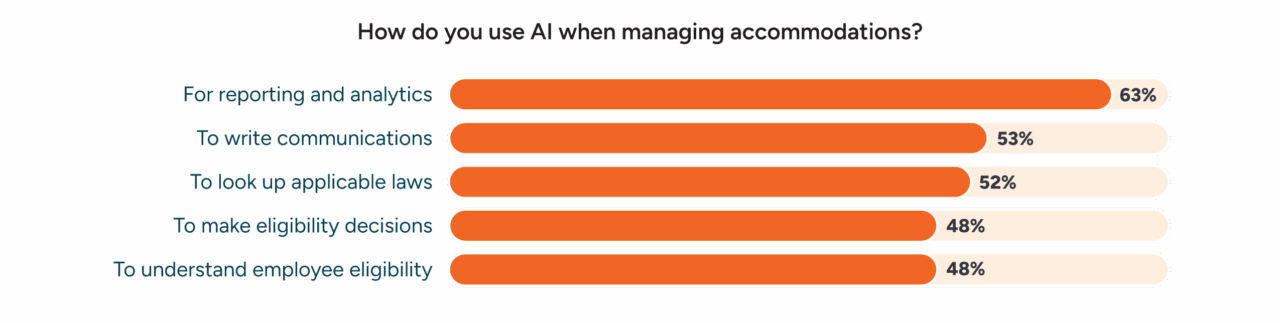
It’s an understandable move: HR is burdened with more accommodation requests than ever, and practitioners are using available resources to boost their efficiency. The problem, however, is that AI can introduce compliance risk when used without clear guardrails or embedded oversight. When paired with manual processes, AI may lead to inconsistent decisions, hallucinations, or failure to meet certain legal requirements. AI should not be used to make major decisions, like determining undue hardship.
That’s not to say AI has no place in the accommodations process. When HR uses purpose-built tools that include expert oversight and incorporate the human touch, it can automate much of its administrative workload without introducing risk.
For more insights into how HR teams are managing accommodations, download our 2026 State of Leave and Accommodations Report.
Elevate Your Approach to Accommodations with AbsenceSoft
When your organization partners with an accommodations management platform like AbsenceSoft, it will gain the tools it needs to deliver a positive, compliant, and efficient accommodations experience. With AbsenceSoft, you’ll have access to:
- A self-service portal where employees can submit requests for accommodations discreetly. Employees can also make requests for leave — a top accommodation — in the portal, too.
- A dashboard that allows employers to track the status of requests.
- A platform that centralizes communications, making them effortless and efficient.
- The AbsenceSoft Compliance Engine™, which tracks over 200 state and federal laws — including laws with accommodations provisions, like the Americans with Disabilities Act and the Pregnant Workers Fairness Act.
- An integrated that allows HR teams to handle requests more efficiently and respond to requesting employees more quickly.
- Technology that leverages intelligent automation, making the interactive process fully standardized across all employee groups.
To learn more about how AbsenceSoft can improve your organization’s approach to accommodations, book a demo today.